Tuesday, November 1, 2016

Week 8: Research on Mongrel


Mongrel grew out of a series of powerful cultural and political exchanges at Artec in 1995 (The London Technology Centre) which was located in Islington London. Artec specialised in the arts, and training for the long term unemployed as well as taking on some commercial work).

Harwood was teaching a group of people on a one-year European Social Fund course at Artec skilling them up for a digital future. Harwood had just finished the installation version «Rehearsal of Memory» and needed help to create the CD-ROM version of the project. Students including Richard Pierre-Davis stayed on after the end of the course ended to help create the CD-ROM. «Rehearsal of Memory,» which went on to be very successful featuring at many festivals around the world.


During this time it became apparent that there was little critical attitude to the exclusive nature of the emerging technologies. Some of the black students were finding it hard to get a foothold in the industry while others students wanted to explore the technologies for their own social/experimental, artistic reasons.

Their appeared to be no space for this to happen within Artec or outside. Students discussed setting up a Mongrel organisation to explore their own ways of making things. Matthew Fuller and Graham Harwood were creating proposals for «Natural Selection.» Using the successes of previous projects, Harwood asked Richard Pierre-Davis and Matsuko Yokokoji to join him in a project looking at «National Heritage» this slowly cemented into Mongrel with Mervin, who was also on the course at Artec, joining sometime later.

Everything Mongrel does evolves around audience participation on a deep level. Their work fits both in the category of physical interface and software in this context, but I always have found their dedication to establishing connections with people through physical meetings and education the most intriguing. The Mongrel approach to social, cultural and political systems or structures is deconstructive and experimental. 


Matsuko Yokokoji
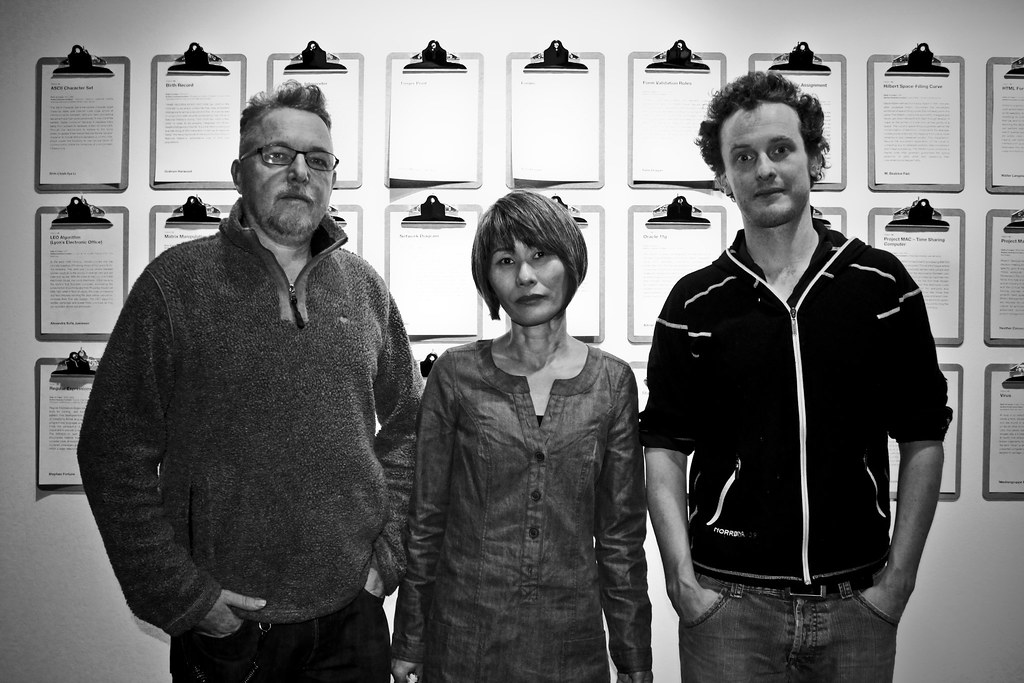


Image result for matsuko yokokoji

yoha

picture; Jamie Woodley, Yoha, Bristol City Council House


Image result for Matsuko Yokokoji works
Graham Harwood and Matsuko Yokokoji : Coal Fired Computers (2010)

Matsuko Yokokoji co-founded the Mongrel group in 1995 with Graham Harwood. She graduated from Kuwazawa Design College in Tokyo in 1983. Two years prior to this she freelanced as a graphic designer and became the art director for Imperial Enterprise Inc. a company specialising in direct marketing, in 1984. Yokokoji first came to the UK in 1987 to study printmaking and computer graphics at Guildhall University where she first met Harwood (another founder member of Mongrel). From 1991-1995 she worke````````````````````````````````````````````````````````````````````````d as a researcher/coordinator for Japanese TV companies. In 1994 Yokokoji worked for Harwood's ‘Rehearsal of Memory' which first showed at Video Positive 94' and later it became a CD-ROM of which the installation travelled to 12 cities and 9 countries. ‘Rehearsal of Memory' is part of The Centre Pompidou's permanent collection.

Image result for Matsuko Yokokoji works
Invisible Airs & Endless War


One of their attractive works in our opinion is:


Telephone Trottoire

Pilot March 27th to May 8th, 2006
The aim of the “Telephone Trottoire” project was to engage the London based Congolese community in issues that affect our day-to-day lives. “Telephone Trottoire” is based on a new form of “contagious” telephone application developed by Mongrel and named after the Congolese practice of “pavement radio” or the passing around of news and gossip between individuals on street corners.
In Central Africa people defy media censorship by sharing news and gossip using 'radio trottoire' or 'pavement radio'. Built in collaboration with the radio programmes “Nostalgie Ya Mboka” and “Londres Na Biso” (www.nostalgieyamboka.net), "Telephone Trottoire" encourages London's Congolese community to pass around news stories and discuss them using a unique system of sharing content over the phone.
What deemed as interesting here is that the used an everyday thing and implemented technology into it. They even have introductory message users hear when they answer the call.

References 
http://research.gold.ac.uk/949/
http://yoha.co.uk/node/639


Week 7: Art HACKATHON

Art Hackathon

Fifty artists-hackers and hacker-artists got together over a weekend in a big space to create an art exhibition from scratch and demonstrate the expressive potential of new technology and the power of radical collaboration in art. In my opinion it is amazing what they are doing instead of using hacking for bad purposes. They make exhibitions from scratch after spending hours on hacking and collaborate with one another with their ideas. 

Image result for art hackathon

Image result for art hackathon


One of the works created: Museum of Lies


Team: James Green, Maia Smith, Jodi Crisp, Catherine Jones, Mike Alger, Tom Flynn

Description:

The Museum of Lies is an exploration of how the stories of historical objects can be told, retold ... and falsified.
Their creation grew from the premise that Museums (capital M) don’t always tell the whole truth - think of replica masterpieces or conjecture in object descriptions - or leave out parts of an objects story that are considered incompatible with the ‘official’ narrative (e.g. the ‘Elgin Marbles’).
Their team ended up creating two ways to present such concepts through interactive experience:
  • A VR museum that presented 3D scans of objects in a replica of the actual space the user was in (we 3D scanned the Ravensbourne college foyer!) and pulled in an infinite stream of altered and falsified Wikipedia articles related to them, displaying the text in realtime in the 3D environment.
  • An Arduino based physical interface that used 3D printed artefacts to trigger an information display pulling in the same edited Wikipedia descriptions, complete with rotary controllers to ‘turn up the lies’.
References: 
http://arthackathon.co.uk/artworks.html#museumoflies
http://arthackathon.co.uk/artworks.html
http://hackingarts.com/

Week 6: Group Proposal


Introduction: 

‘The Visualla’ (the walking canvas) is technologically savvy equipped with moods when temperature changes. With various designs in place, we aim to brighten up your day rain or shine.


Temperaments: 
Our umbrella reacts accordingly to the temperature of the weather so users can use it whenever and wherever. Apart from shielding rain, it will come in handy when the sun rays get too tough.

Thermochromic pigment
  • Activation temperatures : -15C ~ 70C
  • Heat resistant: Max anti-temperature can go up to 280 degree


Mobile App:
Choose presets or “moods” beforehand so users don’t have to meddle with their phones upon using the umbrella.

DIY own designs on top of presets/moods

weather prediction: app connected to The Weather Channel
“moods”

Easy accessibility:
Users can simply switch on the activation button at the handle of the umbrella or the app on their phones upon downloading it.


Layout Examples

6a9446a96f9568ce29f401cec4cec0fe.jpg41740672a2ae2a0050be19026d983561.jpg


Ref: https://www.youtube.com/watch?v=Ed0TwULyl6o


Materials Needed

  • Thermochromic pigment: changing color by its activation temperature (eg. mood rings)
  • Hydrochromic Screen Printing Ink: white when dry and clear when wet, once the hydrochromic ink dries it goes white again  - to hide messages, colours and text. (for DIY)
  • Motion sensor


Reference:
PILEUS - The Internet Umbrella

Image Ref: http://www.coin-operated.com/2010/05/04/umbrella-net-2004/

Main Functions:
Photo-sharing and 3D Map Navigation

Umbrellas > Connected via Bluetooth > Miniature PCs > Public Performance Art How does the umbrella work?
Encompasses of:
large screen on the top surface
a built-in camera
a motion sensor
digital compass
GPS
connected to a major web service: Flickr API
user can take photo with a camera on the umbrella, and pictures are uploaded to Flickr in two minutes with context tags via a wireless Internet connection

+

watch photo-streams downloaded from Flickr with simple operation of wrist snapping

shows a 3D bird view around the user. User can walk-through a city comparing the 3D views and real sights, and the map is always updated by GPS and a digital compass


*provides social local-navigations and real-time in-place communications


Week 5: Singapore Night Festivals 2016

The Singapore Night Festival returns for the ninth edition this year, with the theme Inventions And Innovation. The festival takes place over four nights - 2 weekends. Organised by the National Museum of Singapore, it is expected to draw big crowds - 600,000 people went to last year's edition. The Singapore Night Festival brings a nocturnal extravaganza right in the heart of the heritage district of the Bras Basah-Bugis precinct.
There are 5 different zones as part of the Singapore Night Festival. 
Zone 1: National Museum of Singapore (Main festival zone)
Zone 2: Armenian Street (Dance parties, Experimental performances & Light installations)Zone 3: Cathay Green, SOTA & Prinsep Street (Ticketed local performances at Cathay Green, & Night Buskers)Zone 4: Festival Village (SMU Campus grounds with local bands, flea market and food kiosks)Zone 5: Singapore Art Museum, Queen Street, Waterloo Street & National Design Centre (Artistic performances & Light installations)
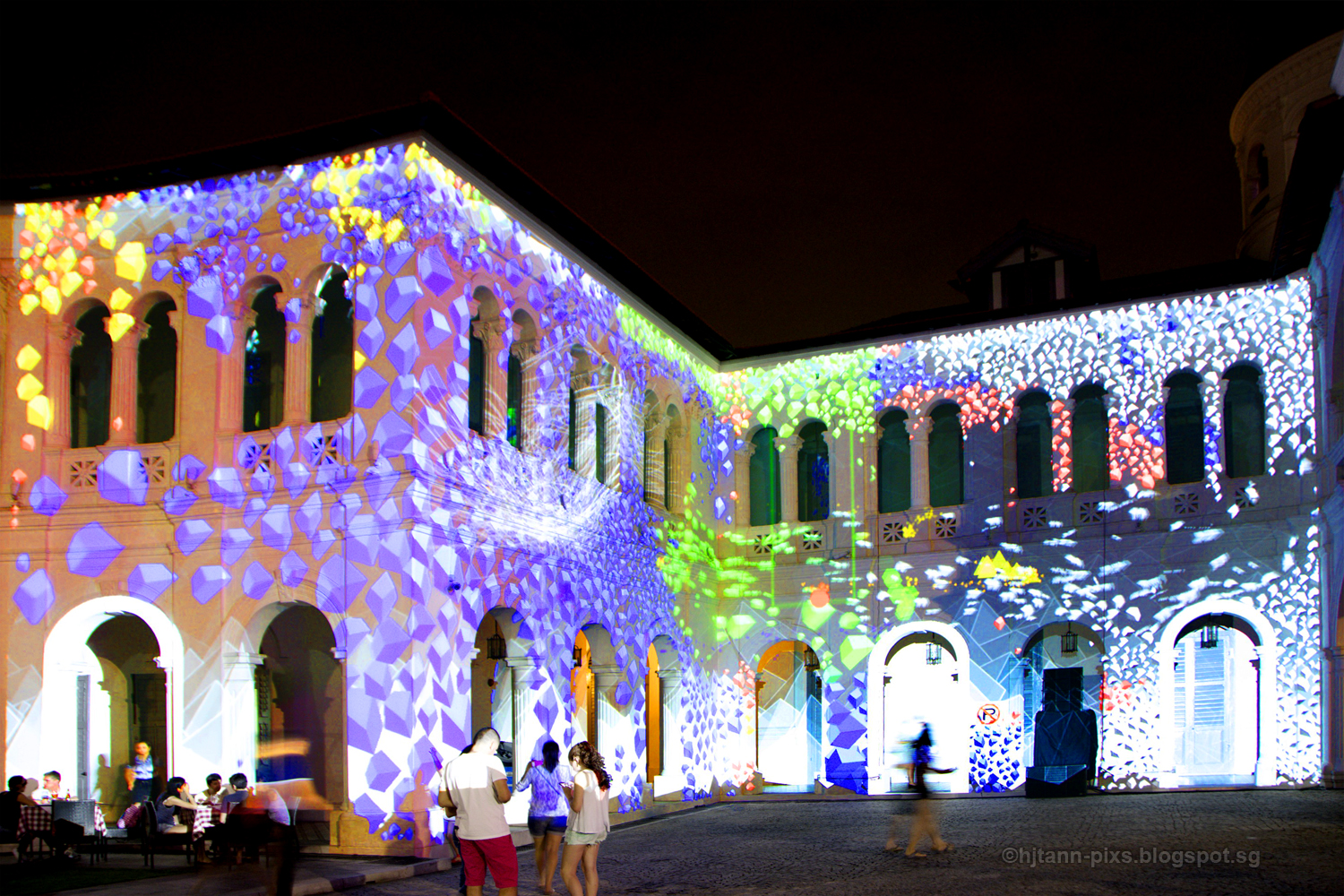
I managed to catch all the zones except zone 3. What caught my eye was apparently the centerpiece of Singapore Night Festival which was the Keyframes. It offers narrations of the city, where bodies and movement play main roles of telling a story upon the stately National Museum of Singapore facade. The blinking lights and movements of the body sticks were captivating to watch.
Through micro-stories weaved upon the stately National Museum of Singapore façade, KEYFRAMES offers narration in the city – urban stories where bodies and their movements play main roles. Part animation and part moving sculpture, the LED figures and their routine imbue static buildings with energy and excitement. This new installation – part of the KEYFRAMES series – brings glimmers of the past to life.
Image result for singapore night festival

The Singapore Night Festival is not just about visiting museums in the night, the local artworks and talents on display. Along with musical performances from modern hip-hop to drumming, there would be something interesting for visitors to explore and enjoy the arts scene in Singapore for the young and old, locals and visitors alike.


Week 4: Pileus

PILEUS: The Internet Umbrella
By Sho Hashimoto and Takashi Matsumo

The photo function is connected to a major web service: Flickr API. A user can take photo with a camera on the umbrella, and pictures are uploaded to Flickr in two minutes with context tags via a wireless Internet connection. User can also enjoy theirselves watching photo-streams downloaded from Flickr with simple operation of wrist snapping.

Pileus Internet Umbrella Pileus Flickr Umbrella 


It also has a function of 3D Map. Detecting a location data from GPS, it shows a 3D bird view around the user. User can walk-through a city comparing the 3D views and real sights, and the map is always updated by GPS and a digital compass. It aims to create natural augmented reality with a large informatin screen on the umbrella. Pileus is an umbrella connected to the internet to make walking in rainy days fun. Pileus has a large screen on the top surface, a built in camera, a motion sensor, GPS, and a digital compass. The current prototype has two main functions: photo-sharing and 3D map navigation.


Pileus with Map 

Image result for the internet umbrella

Image result for the internet umbrella

Image result for the internet umbrella

Image result for the internet umbrella

Image result for the internet umbrella

These two functions can be switched by simply fliping a switch. As a future direction of its development, putting a context data on the Internet (e.g. geo-tags on photos), it will be able to provide social local-navigations and real-time in-place communications. The product aims to provide an augmentation of everyday life synchronizing information on the Internet and the real place. 

It is interesting to browse the 'future' while in the rain however in my opinion the user might bump into people while walking and it is not safe or feasible even to use the umbrella especially under rain.

reference:
http://www.pileus.net/
http://www.pcmag.com/slideshow_viewer/0,3253,l=204409&a=204399&po=4,00.asp


Week 3: Pipilotti Rist


Pipilotti Rist was born on June 21, 1962 in Rheintal, Switzerland.

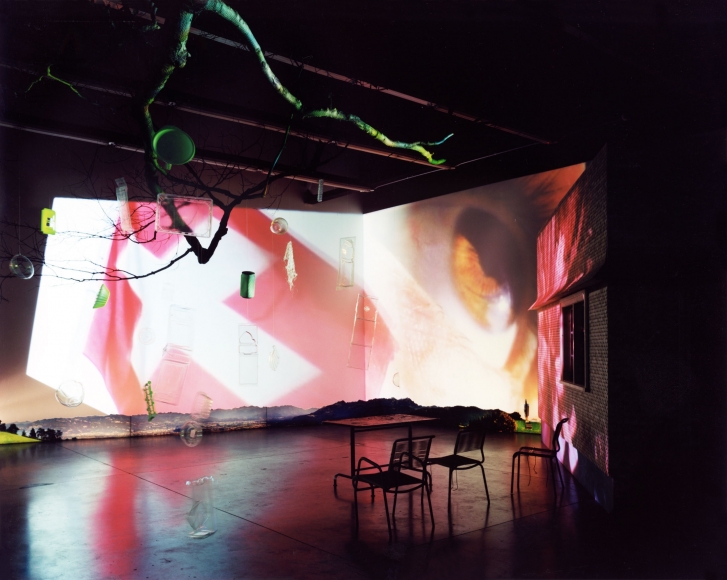
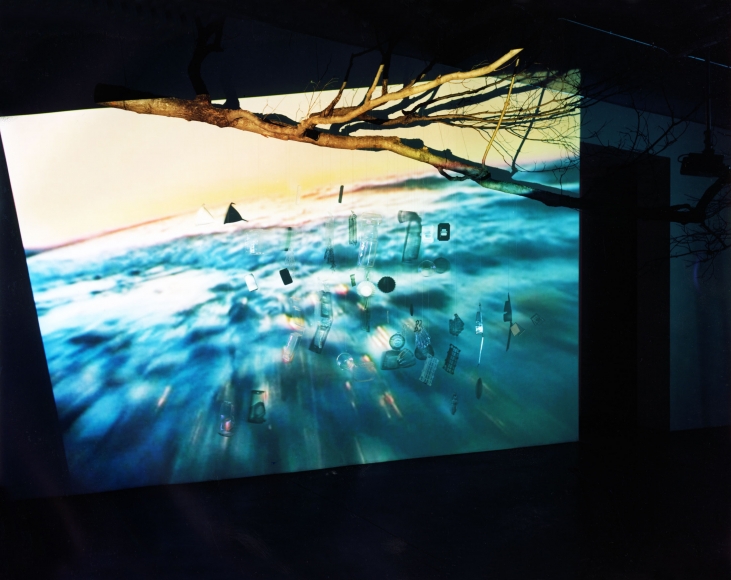
Her focus is video/audio installations because there is room in them for everything (painting, technology, language, music, movement). Her opinion on art is to contribute to evolution, to encourage the mind, to guarantee a detached view of social changes, to conjure up positive energies, to create sensuousness, to reconcile reason and instinct, to research possibilities and to destroy clichés and prejudices. 


Rist's works have been exhibited widely at museums and festivals throughout Europe, Japan and the US, including the biennials in Sao Paulo, Venice, Istanbul, the Caribbean and Santa Fe. In 2000 the Public Art fund NY commission Open My Glade, was shown on the screen in Times Square. Pipilotti Rist's multimedia video works such as, I'm Not The Girl Who Misses Much (1986)‚ Yoghurt on Skin, Velvet on TV (1995)‚ Sip My Ocean (1996), and Remake of the Weekend (1998), blur the boundaries between visual art and popular culture and explore the unfamiliar in the everyday. Her lush, seductive images recruit the idiom of commercial advertising and music videos to create a highly individual artistic language informed by her past in a music band and as a set designer.

Pipilotti Rist
Herbstzeitlose: (Saffron Flower or Fall Time Less)
Installation view
Luhring Augustine, 2003

Pixelwald (Pixelforest)\

Worry Will Vanish Horizon

Gnade Donau Gnade2

Image result for ever is all over


Pipilotti Rist, "Ever is Over All," 1997

Image result for ever is all over


My initial impression of Rist's work was that it gave off an impression of dancing on the scarcely finely line between what is art and what is definitely not. A decent segment of her art is hard to comprehend – In I'm Not the Girl Who Misses Much, for example, Rist moves around half nude singing "I'm not the young lady who misses much" at an earsplitting pitch. In the wake of perusing the depiction of what she endeavors to accomplish in her art, in any case, her work turned out to be much clearer to me. I believe Rist's treatment of this line amongst workmanship and not craftsmanship is the thing that makes it compelling. The message is not promptly obvious, yet the provocative visual and sound segments make the work difficult to disregard – I wound up attempting to determine importance long after I had seen the video. Rist's MoMA establishment, Ever Is All Over, was particularly powerful in doing this. The video highlights a lady strolling down a city road, ceasing to crush in the windows of autos now and then. At a certain point a police lady stops to welcome her, then passes on. I found the cheerful state of mind of the lady to be the most fascinating part.


References:
http://www.hauserwirth.com/artists/25/pipilotti-rist/images-clips/